THANK YOU FOR BEING A WAH LUM MEMBER!
Welcome to Wah Lum! Thank you for taking this wonderful step to improve your health. The benefits of Tai Chi will improve your well-being both mentally and physically. The core style you will be learning is the beautiful 108 Movements of the Yang style.
PREPARING FOR YOUR FIRST DAY
- Please arrive 15 minutes prior to class to CHECK IN on the iPad or laptop in the front office, and allow time to warm up.
- There is a convenient key rack located by the bathrooms and on the left patio for your personal items.
- Extra uniforms and shoes can be purchased in the front office. We also have water, Gatorade, and quick snacks for sale.
SCHOOL RULES AND EXPECTATIONS
Uniforms:
- To promote unity and focus, the full uniform must be worn to participate in class (Wah Lum issued Tai Chi jacket or T-shirt, pants, and shoes).
- Please do not alter the uniform. Additional uniforms are always available for purchase in the front office.
Class Etiquette:
- Please arrive at least 5 minutes prior to your scheduled class.
- Students must bow before entering and leaving the Temple, as well as to greet instructors and one another, as a traditional sign of respect.
- Respect one another as family. Treat all instructors (Great Grandmaster, Master Suzy, Master Mimi, Sifus) with respect, and all classmates as your brothers and sisters.
- To maintain the purity of the system, students are not permitted to instruct or teach other students.
- No eating, drinking, or profanity is allowed on the training floors.
- Please do not lean against the walls or mirrors.
- Please help us keep the school clean!
Campus Waiting Area & Parking Policy:
- If you have a spouse or guest waiting for you on campus, they are welcome to relax by the fish pond. However, to minimize distractions, we ask that guests refrain from observing active classes.
- Clean Air Rule: We frequently train outdoors. If your ride prefers to wait in their car with the AC running, they must park further away (near the Wah Lum Cultural Center or adjacent grass area) and not near the training zones, so our students have clean air to breathe. If parked near a training zone, the engine must be turned off.
Photo / Video / Social Media:
- To maintain a peaceful environment, photography is not permitted during class. You may take photos in uniform before or after your session!
- You may post PHOTOS ONLY and TAG us at @wahlumtemple on Instagram or Facebook.
- To protect the privacy of our students and the traditional Wah Lum system, any videos taken at the Temple may not be shared publicly (Facebook, YouTube, Instagram, etc.) without permission.
- Please refrain from videotaping forms and posting them online. Great Grandmaster Pui Chan has worked hard to keep the system traditional and ensure students learn only from certified Sifus.
Weapons:
- Advanced students must purchase their own personal weapons. Do not use other students’ weapons without permission.
- All weapons must be stored safely in the designated weapons rack.
Communications & Updates:
- A short, informative weekly newsletter will be sent with important schedule updates. Please read it to stay in the loop! (Your information is never shared).
- If at any time you change your email, contact info, or bank account, please notify the office immediately.
Temple Safety:
- For your safety, the plum flower poles and any garden areas are strictly off-limits.
- Please watch your step on the left and right patios! The cement slabs have a 12-inch drop-off on the sides, so please maintain a safe distance from the edges.
- If you are being picked up, please wait safely on the porch as the parking lot can get very busy.
- Please enjoy the beauty of our plants and fruits with your eyes only; do not disturb or eat them.
TRADITION & CULTURE
At Wah Lum, we emphasize the importance of learning Tai Chi within the framework of tradition and culture. Respect is a fundamental value in the Wah Lum system, and we demonstrate it in various ways.
Bowing
A gesture of respect toward instructors and fellow students. At Wah Lum, we bow with the left fist and right hand, following the tradition of our Northern-style Kung Fu. This gesture was passed down to us by Great Grandmaster Pui Chan.
Addressing Instructors
Using proper titles shows honor and respect for their role and experience. Below are commonly used Chinese terms in our school:
- Sigung: Great Grandmaster (Great Grandmaster Pui Chan)
- Simo: Direct translation ‘sifu’s wife’ (Simo Suzy is technically SiPo as the Great Grandmaster’s wife. Tai Chi students may address her as Master Suzy or Sifu Suzy).
- Sifu: Instructor, teacher. At the Temple, certified instructors are referred to as Sifus.
- Si Hing: Older martial arts brother. Used when addressing male assistant instructors.
- Si Jye: Older martial arts sister. Used when addressing female assistant instructors.
Temple Terminology
- Count to 10 in Chinese: yat, yee, samm, sei, umm, luk, chut, baat, gau, sap
- Bisan: To light incense out of respect for previous masters.
- Gau Jung: Signifies the end of class. When you hear this, all students are being called back together to bow out and formally close the session.
Wah Lum Martial Arts Altar
In Chinese culture, the martial arts altar is a place of respect, honoring the ancestors and masters who came before us. Bowing to the altar is a gesture of gratitude and discipline, thanking them for passing down their knowledge. The altar reads:
- Right side: Jeen Jo, Jeen See, Jeen Gaau Do (Respect Great Grandmaster, Respect Sifu, Respect Teachings Being Taught)
- Left side: Hok Yan, Hok Yi, Hok Kung Fu (Learn Kindness, Learn Fellowship, Learn Hard Work)
- Middle: Foh Gee Do Jin (Control)
- Top: Wah Lum Pai (Wah Lum System)
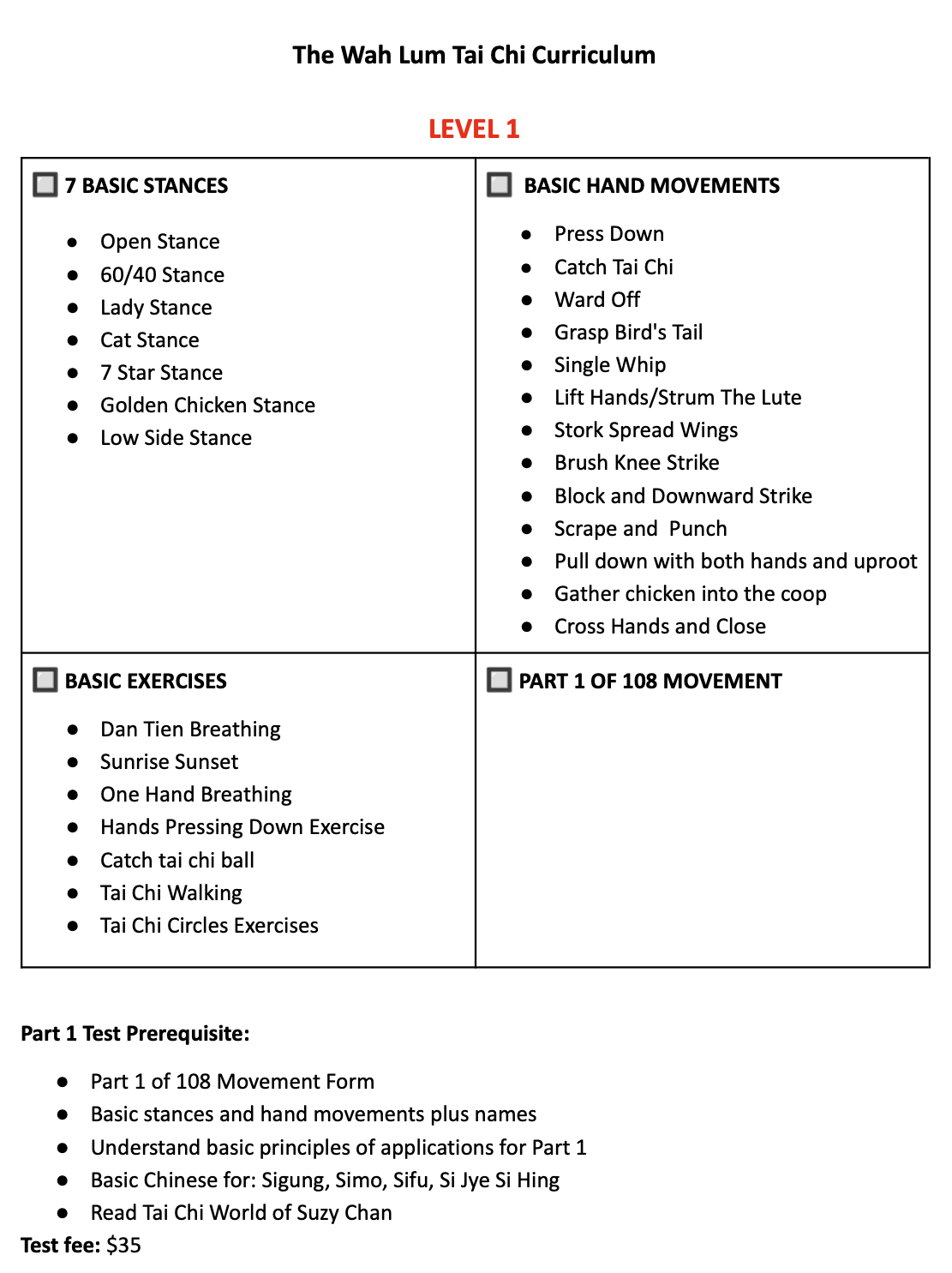
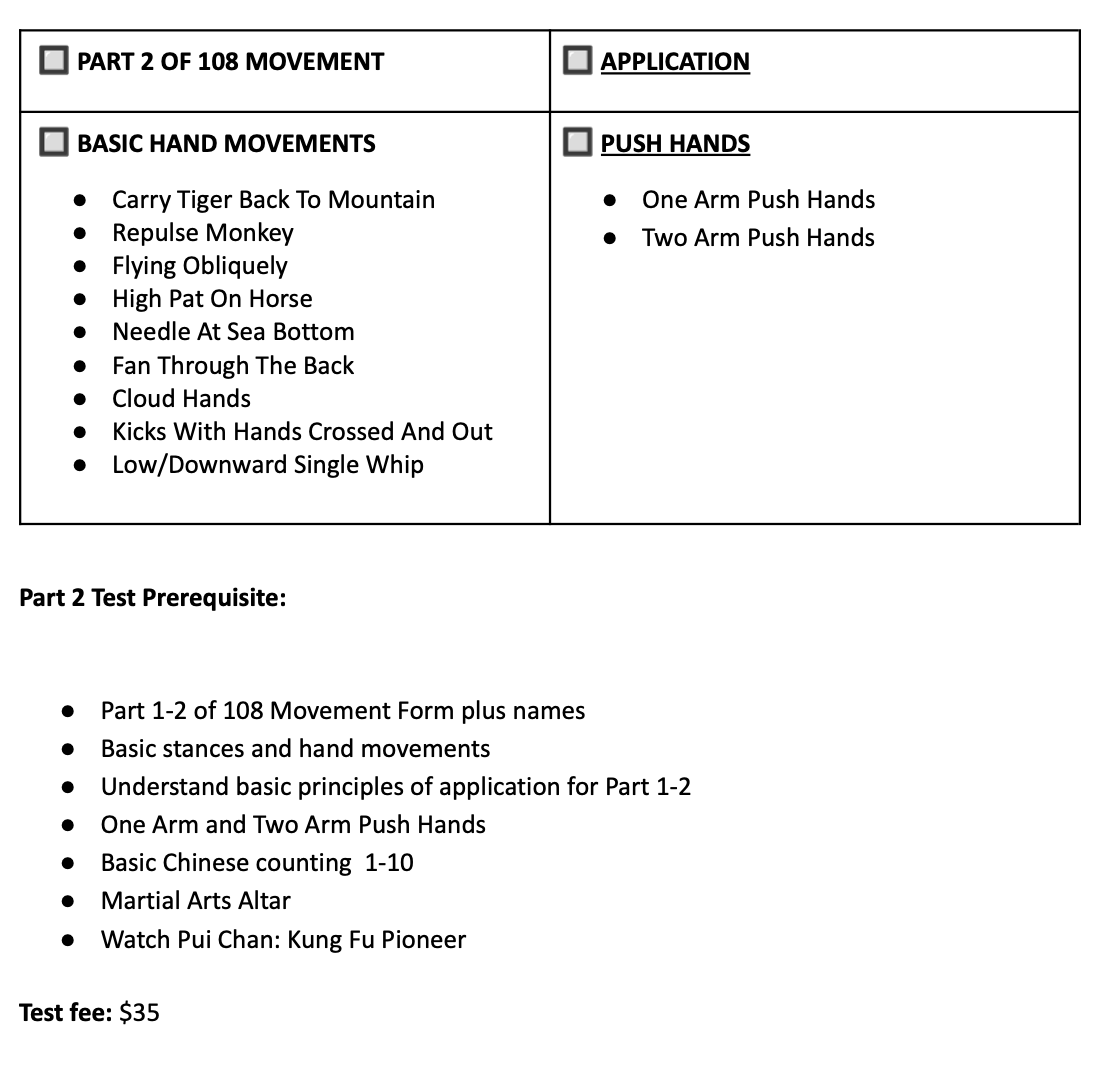
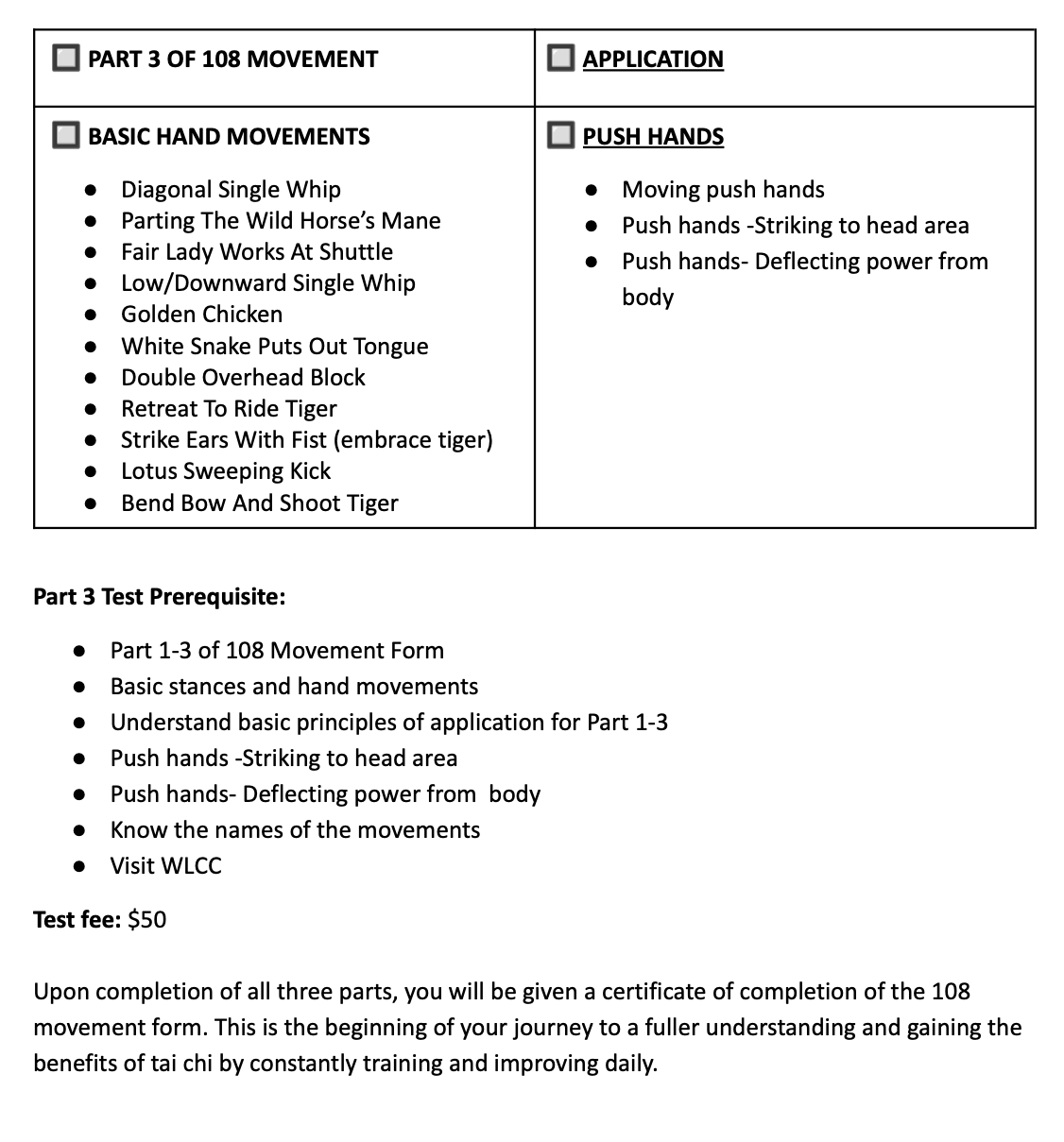
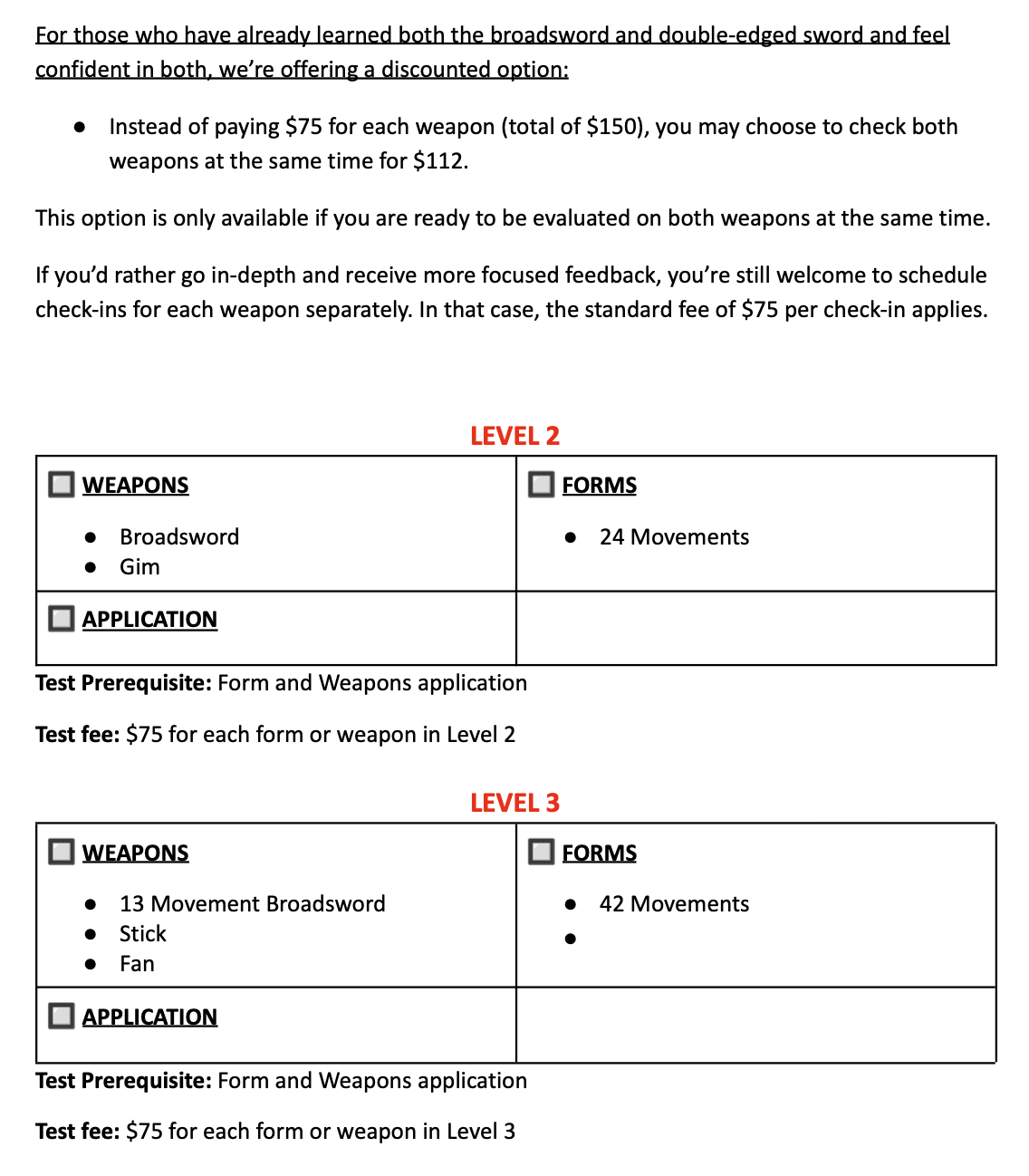
THE WAH LUM TAI CHI CURRICULUM
Our Tai Chi curriculum is thoughtfully designed to reflect the unique philosophy and tradition of the Wah Lum system. It serves not only as a guide to learning forms and techniques, but as a pathway to understanding one’s own journey.
The curriculum is structured to inspire students at every level—offering clear milestones, regular checkpoints, and the tools needed to build a strong foundation. True mastery takes years, and within each level, students are encouraged to revisit and refine their practice—growing deeper within the system rather than simply moving on.
Testing Policy & Checkpoints:
Testing and checkpoints are built into the curriculum to ensure your foundation is solid before progressing. You will test once you have reached a certain level. An instructor will inform you when you are ready, and registration info will be sent by email. Students should view these tests as valuable one-on-one time with a Sifu, designed to support their growth.
Upon completion of all three parts, students are required to review and refine their practice—growing deeper within the system rather than simply moving on.
TAI CHI YANG STYLE: 108 MOVEMENTS
PART ONE
Preparation
Catch Tai Chi/right – Ward off (Tai Chi left)
Grasp bird’s tail (4 movements)
Turn – single whip
Lift hands
Stork spreads wings
Tiger wash face
Brush knee twist step (3 times)
Hands strum lute
Deflect downward, parry and punch
As if shutting a door
Cross hands
PART TWO
Wah Lum
Carry tiger back to mountain
Grasp bird’s tail (4 movements)
Turn / Stork spreads wings
Step back and repulse monkey (3 times)
Flying Obliquely (side fly)
Lift hands (2 movements)
Stork spreads wings
Tiger wash face
Brush knee twist step
High pat on horse
Needle at sea bottom
Fan through the back
Turn / deflect downward, parry and punch
Grasp bird’s tail
Turn, single whip
Cloud hands (3 movements)
Flying Obliquely (side fly)
Kick to left/kick to right (hands crossed and out)
Step across left leg and kick with sole
Deflect downward, parry and punch
Grasp bird’s tail
Turn, single whip
Downward single whip
Flying Obliquely (side fly) (2 movements)
Stork spreads wings
Tiger wash face
Brush knee twist step (3 times)
Deflect downward, parry and punch
As if shutting the door
Cross hands
PART THREE
Carry tiger back to mountain
Grasp bird’s tail (4 movements)
Diagonal single whip
Parting the wild horse’s mane (right/left/right)
Catch Tai Chi/right – Ward off (Tai Chi left)
Grasp bird’s tail (4 movements)
Turn, single whip
Fair lady works at shuttle (4 directions)
Grasp bird’s tail (4 movements)
Turn, single whip
Cloud hands (2 movements)
Single whip
Downward single whip
Golden Chicken (2 times block – right/left)
Step back and repulse monkey (2 times)
Rotate Hands Catch Tai Chi
Flying Obliquely (side fly)
Lift hands
Stork spreads wings
Tiger wash face
Brush knee twist step
High pat on horse
Needle at sea bottom
Fan through the back
Turn/white snake puts out tongue
Deflect downward, parry and punch
Grasp bird’s tail (4 movements)
Turn/ Single whip
Downward single whip
Seven star block
Retreat to ride tiger
Strike ears with fist (embrace tiger)
Lotus sweeping kick
Bend bow and shoot tiger
Deflect downward, parry and punch
As if shutting the door
Cross hands
Key Reminders for Practicing Tai Chi:
- Posture: Imagine a string gently pulling up from the top of your head.
- Deep Breathing | Relax Shoulders and Body
- Circular Movements | Waistline Power
- Shifting of Weight | Stance Work
FREQUENTLY ASKED QUESTIONS
What age should I start practicing Tai Chi?
Tai Chi is beneficial to everyone! We encourage adolescents 14+ to start their training.
Is Tai Chi good for self-defense?
Tai Chi is a martial art, and it has self-defense movements within it. However, we teach Tai Chi for its incredible health benefits first, and self-defense second.
What do I do after I finish the 108 Movements of Yang?
There are several beautiful weapons forms and other advanced Tai Chi forms in the curriculum for those who want to further their training.
I have just had surgery; can I practice Tai Chi?
Yes, we encourage doing some form of exercise after surgery, and Tai Chi is one of the best programs for recovery! (Please always ask for your doctor’s advice and clearance before starting any exercise program).
I have back problems and knee problems. Is this good for me?
Make sure you let your instructor know of your situation. Tai Chi is not a “fix-all” exercise, but it will help strengthen your body and legs, which often helps with pain management.
I suffer from stress and anxiety; is this good for me?
Yes! One of the many benefits of Tai Chi is relieving stress. We do deep breathing exercises that help calm and regulate the nervous system.